
Public Lesson · Week 1 · Story of Self
Why labeling the problem has never been the same as solving it, and what narrative does that diagnosis cannot.
Connect · Character
When the diagnosis is correct and the person still doesn’t change.
If you have worked in behavioral health for more than a year, you already know what I am about to describe.
A client arrives. They are assessed. The diagnostics are run. The DSM criteria are met. A treatment plan is built around the findings. The clinicians are skilled, the intentions are right, and the process is followed exactly as it was designed to be followed.
And the client leaves. And returns. Or doesn't return at all, which is somehow worse.
The diagnosis was accurate. The treatment was appropriate. So why didn't it work?
“Diagnosis identifies the problem. It has never been designed to answer the deeper question: who is this person, and who are they becoming?”
Problems · Challenge
We borrowed a tool from engineering and applied it to identity. That is the problem.
Diagnosis makes perfect sense when the system you are analyzing is a machine. A car engine misfires. You run diagnostics. You find the faulty part. You replace or repair it. The engine runs again. The logic is clean because machines do not have narratives. They do not carry stories about who they are and what they deserve. They do not make meaning out of their malfunction.
Human beings do all of those things. Which is why applying diagnostic logic to a human identity is not just limited. It is the wrong tool entirely.
THE DSM PROBLEM
The DSM has been revised multiple times and the scientific criticism has grown with each edition. Peer-reviewed research published in leading psychiatric journals has concluded that major revisions were driven by professional opinion rather than replicated scientific evidence. The DSM-5 Field Trials documented lower diagnostic reliability than any prior edition.
And in 2013 the director of the National Institute of Mental Health announced the NIMH would no longer fund research built on DSM criteria. The most powerful mental health research institution in the country walked away from the manual. The diagnosis is a starting point. It was never designed to be the whole story.
Sources: Ghaemi, N. (PMC6127747); Chmielewski et al., Journal of Abnormal Psychology (PMC4573819); NIMH Director Thomas Insel, 2013
Here is what diagnosis does to a vulnerable person who walks through your door already convinced something is fundamentally wrong with them.
It confirms it.
You have depression. You have PTSD. You have an anxiety disorder. You have ADD. You have a substance use disorder. Each label is clinically accurate. Each one is also a ceiling. Because the moment a person absorbs that label as identity, the question they carry is no longer "who am I becoming?" It becomes "how do I manage what I am?"
Those are not the same question. And they do not lead to the same life.
Insight · Choice And Cave
Identity is not a diagnosis. It is a story in constant evolution.
Consider something simple before we go further.
Are you the same person you were at five years old? In some ways, yes. That child is part of who you are. But you are also someone that child could not have imagined. You have been shaped by everything that has happened between then and now. By choices you made, things done to you, losses you survived, and moments that rewired how you see yourself.
That is not a disorder. That is a story.
A diagnosis freezes identity at the point of greatest pain. It says: this is what you are. Story understands identity as something always in motion. It asks: this is where you have been. Now where are you going?
“The brain does not heal through diagnosis. It heals through narrative.”
WHAT THE NEUROSCIENCE SHOWS
Neuroscience research shows that narrative activates regions of the brain well beyond language processing, including areas responsible for memory, self-referential thinking, and future planning. When trauma disrupts the brain's ability to create coherent story, the hippocampus, which sequences events in time, goes offline. Memory becomes raw sensation without meaning. Flashbacks without context. Emotion without a way through.
Healing, the actual neurological process of it, involves rebuilding the narrative. Not erasing what happened. Re-sequencing it into something the brain can integrate and move forward from. Emerging research in narrative therapy and neuroplasticity is now examining how re-authoring personal stories directly impacts brain structure in regions linked to emotion regulation and self-awareness.
Story is not a soft add-on to treatment. It is the mechanism of change.
Sources: Ferstl et al., extended language network research (PMC6794920); Mark O’Neill, The Neuroscience of Storytelling, 2026; SPU Digital Commons, narrative therapy and neuroplasticity, 2025
WHAT DIAGNOSIS ASKS
What is wrong with you?
What are your symptoms?
What category does your pain belong to?
How do we manage what you are?
WHAT STORY ASKS
What happened to you?
What did that teach you about who you are?
What have you been carrying that was never yours?
Who are you capable of becoming?
One of those question sets produces a treatment plan. The other produces a life.
Resolution · Change
What Story Sees That Diagnosis Cannot: Curtiss.
A STORY FROM THE ROOM
Curtis Callaway entered treatment with every label the diagnostic system could produce. Meth addiction. Multiple felonies. Nineteen of twenty years on probation, parole, or behind bars. A destroyed marriage, a young son, no career, no future visible from where he was standing. He went into treatment, by his own admission, to manipulate the court. These people were marks. He had worked them before.
Diagnosis could see all of that clearly. It named the addiction. It named the co-occurring disorders. It prescribed accordingly. What it could not see was the story underneath.
Curtis grew up with a father cooking meth and a mother in a crack addiction that lasted twenty-five years. At five years old, he was alone in a house with every light on because he was scared. He learned early to blend in with any crowd, to coast, to stay invisible in the middle. Not bad, not great, unseen. Then one afternoon in seventh grade, standing in a hallway in his purple jersey, a girl named Amanda looked at him and said: “What are you looking at, Bucky?” The crowd laughed.
“I always knew I belonged over in Amanda’s group. But I thought I had everyone else fooled. The jig was up. They saw me. School was no longer a safe place. I don’t belong anywhere.”
He quit that afternoon. Not just the pep rally. He quit on himself. And for the next thirty years, every choice he made, the drugs, the crimes, the self-destruction, was the story of a person proving that Amanda was right.
That is not a substance use disorder. That is a broken story about belonging. And no diagnostic label reaches it.
What changed for Curtis was not a diagnosis being corrected. It was a story being seen. In recovery, a man named Lewis called him and said two things no one had ever said to him before: “We were all waiting on you. And I’m not leaving you behind.”
“In an instant, I had the realization that after four years of recovery, I was just that kid standing in the hallway with that purple jersey on. I wasn’t falling to the back of anything. I was quitting on everything and everybody the same way I started quitting thirty years ago.”
He went to the gym. Got on the treadmill. Ran a mile. Then kept running. At mile two, sweat everywhere, he began to cry. Not because it hurt. Because he realized he had never given himself a chance. He ran four miles that day. It was ugly. It took fifty minutes. And it was the moment the story changed.
Curtis is not his diagnosis. He is not his felonies. He is not the kid Amanda laughed at. He is, in his own words, a world changer. Running his own business. Present for his son. All in.
The diagnosis did not produce that outcome. The story did.
Underneath every addiction is a story. Underneath every act of self-destruction is a belief about belonging, about worth, about what a person deserves. You will not reach that belief with a label. You will only reach it with the right questions and the space to tell the truth.
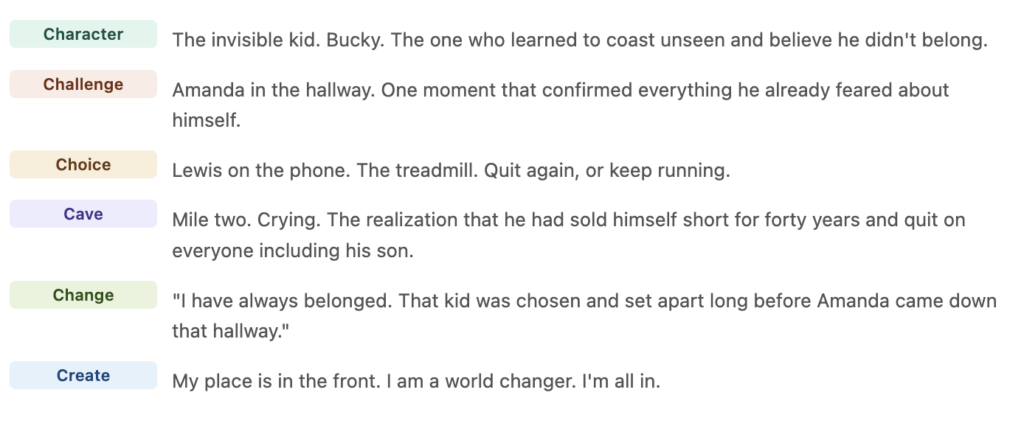
The 6 ‘s In Curtiss’ Story
This is the Story Method at work.
For those new to Story of Self, our curriculum is built around six movements that map every human transformation. You just watched all six play out in one life.
YOUR TAKEAWAY FROM THIS LESSON
This week, think about one client you felt you could not reach. Not because you weren't skilled enough. But because the model you were using didn't go deep enough.
Ask yourself: what is the story underneath the diagnosis? Not what are their symptoms. What happened to them? What did that teach them about who they are? What would change if they could see themselves differently?
You do not need a new curriculum to ask those questions. You just need to decide that the story matters as much as the label.
When you are ready to go deeper, that is exactly what Story of Self was built for.
Story of Self is a narrative therapy curriculum designed for PHP and IOP behavioral health programs. If this lesson resonated, the certification is where it goes deeper.
Built using the Story Method · Story of Self © 2026